
Both the government and RBI have to complement each other if the economy has to revive quickly.

The RBI's decision to hike the benchmark interest rate will make home loans costlier and affect housing sales, especially in affordable and mid-income segments, according to property consultants. The RBI on Wednesday hiked the key benchmark rate by 50 basis points. Property consultancy firms Anarock, Knight Frank India, JLL India, Colliers India, India Sotheby's International Realty and Investors Clinic said that the RBI's move was on the expected line to control inflation and this would result in an increase in interest rates on home loans.
However, some experts also feel that there is a case for front-loading of interest rate cut to give a push to the economy

While enjoying long-awaited economic good times - and hoping they will last as long as possible - some caution and some prudence might be the best protection against bad surprises, says Claude Smadja.

The government may have to resort, eventually and however unwillingly, to printing money, abandoned as policy and practice in the 1990, predicts T N Ninan.

'The Indian economy and the Indian financial sector today remain resilient and much better placed.'

While efforts are being mounted on a war footing to arrest its spread, COVID-19 will impact economic activity in India directly through domestic lockdown. The second-round effects, it said, would operate through a severe slowdown in global trade and growth.

After turning net buyers last month, foreign investors have become aggressive shoppers of Indian equities and have invested Rs 22,452 crore in the first two weeks of August amid softening inflation concerns. This was way higher than a net investment of nearly Rs 5,000 crore by Foreign Portfolio Investors (FPIs) in the entire month of July, data with depositories showed. FPIs had turned net buyers for the first time in July, after nine straight months of massive net outflows, which started in October last year.

investors will look to the new governor to continue the banking sector clean-up with the same urgency as Mr Rajan, who was targeting fully cleaned-up and provisioned balance sheets by March 2017

Terming the RBI action on Wednesday as a "pleasant surprise", analysts today cautioned that possibility of a rate hike in the future cannot be ruled out. Urijit Patel committee's report on monetary policy would clear the air on RBI's future stand, they added.

Prime Minister Manmohan Singh has urged the world economies to continue with stimulus packages till 2010 and avoid all kinds of protectionism including in the financial sector to battle the global economic slowdown.

In its quarterly monetary policy review on January 29, the RBI had announced a 0.75 per cent raise in the cash reserve ratio, or the amount banks need to park with the RBI, from 5 per cent earlier.

The Reserve Bank of India Governor Raghuram Rajan said bringing down inflation would help stabilise the rupee.

Axis Bank was the top gainer in the Sensex pack, rising around 3 per cent, followed by Sun Pharma, Reliance Industries, ONGC, HDFC, ICICI Bank, Kotak Bank and Bharti Airtel. On the other hand, Infosys, IndusInd Bank, HCL Tech, Nestle India and Tech Mahindra were among the laggards.

India achieved the distinction of being the second fastest growing economy amid the global recession in 2009, but the joy was marred by the decade's sharpest rise in food prices to the chagrin of common man.

India's manufacturing sector growth steadied in May, with new orders and production increasing at similar rates to those registered in the previous month, while demand showed signs of resilience and improved further in spite of another uptick in selling prices, a monthly survey said on Wednesday. The seasonally adjusted S&P Global India Manufacturing Purchasing Managers' Index (PMI) stood at 54.6 in May, little changed from 54.7 in April, pointing to a sustained recovery across the sector. The May PMI data pointed to an improvement in overall operating conditions for the eleventh straight month.

The IMF on Tuesday projected an impressive 12.5 per cent growth rate for India in 2021, stronger than that of China, the only major economy to have a positive growth rate last year during the COVID-19 pandemic. The Washington-based global financial institution, in its annual World Economic Outlook ahead of the annual Spring meeting with the World Bank, said the Indian economy is expected to grow by 6.9 per cent in 2022. Notably in 2020, India's economy contracted by a record eight per cent, the International Monetary Fund (IMF) said as it projected an impressive 12.5 per cent growth rate for the country in 2021.
There are more near-term global draggers in store for the domestic stock market, as the central banks across the US, Japan and Europe are likely to further hike their benchmark interest rates

Ahead of the monetary policy review on October 27 by the Reserve Bank of India, he plans to hold consultations with the apex bank and would not like to comment on issues like where interest rates are headed.

Shaktikanta Das is a master of the finest balancing act who listens to all but takes his own decisions, discovers Tamal Bandyopadhyay.

The Reserve Bank (RBI) resisted a 'raid' planned by some in the government to extract Rs 2-3 lakh crore from its balance sheet in 2018 to meet populist spending in run-up to general elections, Viral Acharya, who was deputy governor at RBI at that time, has written.

For the first time in 21 years, the Reserve Bank of India (RBI) will revise norms for investment portfolios of commercial banks to reflect changes in global standards on valuation and measurement, and progress in the domestic market. This could pave the way for banks to transition to the new accounting standards (Ind-AS). The outstanding investment portfolio of commercial banks was at Rs 45.84 trillion as of November 19 this year.

The Sensex opened at 17,537, down 22 points, and soon extended losses and finally ended with loss of 172 points at 17,386. The NSE Nifty ended at 5,222 down 55 points.
Monetary policy stance to depend on inflation data
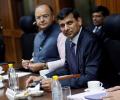
Balance is needed in selecting members for the proposed monetary policy committee, says Abheek Barua.

The rupee plunged 90 paise to close at an all-time low of 80.86 (provisional) against the US dollar on Thursday after the US Federal Reserve's interest rate hike and its hawkish stance weighed on investor sentiments. Forex traders said the US Fed's rate hike and escalation of geopolitical risk in Ukraine sapped risk appetite. Moreover, the strength of the American currency in the overseas market, a muted trend in domestic equities, risk-off mood and firm crude oil prices weighed on the rupee.

In August, the top BRICS leaders at the grouping's summit in Johannesburg approved a proposal to admit six countries, including Argentina, into the bloc with effect from January 1.
Beyond the fourth quarter of 2019, the report does not see space for further cuts primarily as headline inflation is likely to pick up and cross the 4 per cent target by the end of the year, and output gaps are also estimated to close.
.jpg)
The rupee resumed slightly lower at 62.05 per dollar as against the last weekend's level of 62.04 at the Interbank Foreign Exchange market. It recovered to 61.88 per dollar before quoting 61.93 at 1045 hours.

We are much better placed than in 2013 with our overall fundamentals much stronger - higher foreign exchange reserves, a more favourable growth-inflation mix and an institutional framework for targeting inflation, says B Prasanna.
While retaining its forecast for inflation at five per cent this fiscal, RBI has lowered its objective of inflation to three per cent in the "medium term" against 4-4.5 per cent as announced in the last quarterly review in July. "So far as prices are concerned, inflationary development is on track. We expect inflation will end at the level of five per cent, subject to the caveat that oil prices are ruling high and a pass-through may occur," RBI Governor Y V Reddy said.

Broader market outperformed with the S&P BSE Midcap index adding 0.7%, while S&P BSE Smallcap index gained 0.6%.
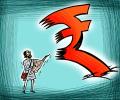
Barry Eichengreen, professor of economics and political science, University of California, Berkeley, analyzes the transparency of the Reserve Bank of India, the growth rate of the Indian economy and why he feels globalisation can never be rolled back.

On the sectoral front, rate-sensitive sectors such as Bankex and Auto gained by 1% and 0.7% respectively while BSE Consumer Durables gained 1.4%.

Gold prices staged a smart rebound to surpass the psychologically important Rs 28,000 milestone.

Attributing price rise to global factors and higher Minimum Support Price (MSP), Prime Minister Manmohan Singh on Wednesday said the government has tried to protect the interest of poor people by maintaining supply through the PDS system.

Fed is still concerned about weak export growth.

RBI could opt for a 'deep cut' after winning inflation war, say experts.

Elevated food price-led inflation could become a sore point for markets, which they seem to be ignoring at current levels, observe analysts. Retail inflation in India - as measured by the Consumer Price Index (CPI) - came in at a three-month high of 6.52 per cent in January 2023, compared with 5.72 per cent in December and 5.88 per cent in November 2022. The inflation print for February, according to Madan Sabnavis, chief economist at Bank of Baroda, will be critical for the Reserve Bank of India's monetary policy committee.
